



Let me tell you something about making money in game development that nobody wants to admit upfront. The income range is absolutely wild. I’ve been making games for seven years now. Some months I’ve pulled in $50,000 from a successful launch. Other months I’ve made literally $200 while working 80 hour weeks on a project that flopped. That’s the reality of this industry.
Game development income varies more than almost any other career path you can choose. Your earnings depend on whether you’re indie or employed, what platform you’re on, what genre you make, how good your marketing is, and honestly just pure luck sometimes. Let me break down exactly what you can expect to earn at different levels of this industry.
Working as an Employed Game Developer
Getting hired at a game studio provides the most stable income in this field. You clock in, do your work, get a paycheck every two weeks. No surprises. The pay varies wildly based on your role and experience level.
Entry Level Positions
Junior programmers at game studios typically start around $50,000 to $65,000 annually. That’s entry level straight out of college or a coding bootcamp. You’re probably fixing bugs, implementing UI elements, or working on smaller systems within the game.
Junior artists and designers make slightly less at most studios. Think $45,000 to $60,000 for your first game industry job. You’re creating assets under supervision, following art direction, learning the pipeline.
- QA testers start at the bottom making $30,000 to $40,000 per year
- Associate producers earn between $50,000 and $65,000 starting out
- Junior sound designers get around $45,000 to $55,000 annually
- Entry narrative designers make approximately $50,000 to $60,000
Mid Level Developer Salaries
After three to five years, your earning potential jumps significantly. Mid level programmers at decent studios pull $80,000 to $120,000 depending on location and company size. I made $95,000 as a mid level gameplay programmer at a AA studio in the midwest. My friend in San Francisco made $135,000 doing similar work because cost of living there is insane.
Senior artists command $75,000 to $110,000 at this stage. Lead designers can hit $90,000 to $130,000 if they’re running teams and making major creative decisions.
Senior and Lead Positions
Senior programmers with ten plus years experience earn $120,000 to $180,000 at major studios. Technical directors and lead engineers can push $200,000 or higher at big companies like Epic, Riot, or Blizzard.
Creative directors and game directors at AAA studios make anywhere from $150,000 to $300,000 depending on the studio size and success of their projects. These positions are extremely competitive and usually require fifteen plus years in the industry.
The employed route gives you stability and consistent income. You sacrifice potential upside for guaranteed paychecks. Some months I miss that stability when my indie income is unpredictable. Other months I’m grateful I took the leap to indie development when a game sells well.
Indie Game Development Income Reality
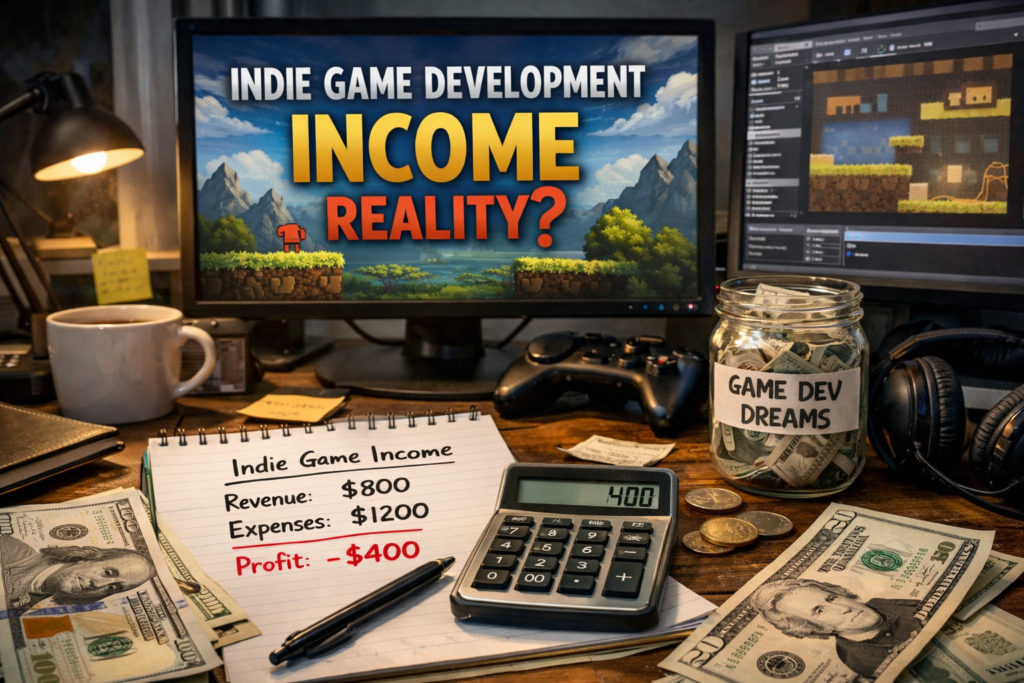
Making games independently is where things get weird financially. The vast majority of indie developers make almost nothing. A small percentage make decent money. A tiny fraction become millionaires.
The Brutal Statistics
Steam releases over 10,000 games per year now. Most of them sell fewer than 1,000 copies total. That means the developer earned maybe $5,000 to $10,000 gross revenue before Steam’s 30% cut. If the game took a year to make, you just earned poverty wages.
I released my first indie game after working nights and weekends for eighteen months. Made $3,200 total. That’s $177 per month of development time. Absolutely brutal math. Almost quit game dev entirely after that experience.
Breaking Down Indie Earnings Tiers
The Bottom Tier
Most indie games fall here. You launch on Steam or itch.io, sell a few hundred copies to friends and random people who stumbled on your store page, earn $1,000 to $5,000 total, then the game disappears into the void. This represents probably 70% of all indie releases.
The Middle Tier
Games that find a small audience and generate $20,000 to $100,000 in revenue. These games usually have strong concepts, decent execution, and got lucky with some streamer coverage or good timing. Maybe 20% of indie games reach this level.
My second game hit this tier. Made $67,000 over two years. Sounds decent until you realize I spent 14 months making it. That’s $4,785 per month. Less than minimum wage after taxes in many places.
The Success Tier
Games earning $100,000 to $1,000,000 in revenue. These are legitimately successful indie games. You covered your development costs and earned a real salary. Maybe 5% of indie games reach this level.
These games usually nail their niche, have fantastic marketing, launch at the perfect time, and get featured by major streamers or in Steam sales. My third game hit $340,000 in revenue. Changed my entire perspective on indie development being viable.
The Jackpot Tier
Games making over $1,000,000 in revenue. We’re talking Stardew Valley, Vampire Survivors, Dave the Diver, Balatro territory. Less than 1% of indie games ever reach this level. The developers become wealthy and set for life if they’re smart with money.
Some indie hits make $10 million, $50 million, even $100 million plus. Minecraft made billions. Among Us made insane money. These are statistical anomalies. Never expect to hit this tier. If you do, consider yourself unbelievably fortunate.
Mobile Game Development Income
Mobile is its own weird beast. Free to play games with in-app purchases dominate. Premium paid games struggle unless you’re already famous or have a massive marketing budget.
The Free to Play Model
Most mobile developers go free to play because that’s where the money is. You need to design for retention and monetization from day one. It’s a completely different skill set than making premium games.
Average mobile game makes almost nothing. Maybe $500 to $2,000 total before dying. The successful ones make bank through ads and in-app purchases.
- Hyper casual games earn through ads and need millions of downloads to profit
- Mid-core games monetize through gameplay boosters and cosmetics
- Gacha games print money through loot boxes and character pulls
- Puzzle games typically run ad-based models with remove ads IAP
I tried mobile development for six months. Released a puzzle game that got 50,000 downloads. Made $4,300 from ads. Sounds okay until you realize that’s after four months of development. Mobile is incredibly hit driven.
Premium Mobile Games
Selling games for $2.99 to $9.99 on mobile app stores is tough. Players expect free games. Getting someone to pay upfront requires either an established brand or exceptional quality that stands out immediately.
Successful premium mobile games usually come from established developers with marketing budgets. Monument Valley succeeded because it looked gorgeous and had marketing support. Stardew Valley on mobile succeeded because it was already famous from PC release.
Different Revenue Models and Their Earning Potential

How you monetize your game dramatically affects your income potential. Each model has advantages and typical earning ranges.
Premium One Time Purchase
You set a price, players buy it, they own it forever. Simple and clean. Most indie developers prefer this model because it feels honest and aligns incentives correctly.
Typical indie premium games price between $9.99 and $24.99. Lower prices get more sales. Higher prices feel premium and attract serious players. I’ve experimented with both. $14.99 seems to be the sweet spot for most genres.
Free to Play with In-App Purchases
Game is free, you monetize through optional purchases. This model can make obscene amounts of money if executed well. It can also make nothing if your game doesn’t hook players.
Typical conversion rates sit around 2-5%. That means 95-98% of players never spend a penny. The whales who do spend often drop hundreds or thousands of dollars. Your entire business model depends on finding and retaining these high value players.
Early Access and Ongoing Development
Release an unfinished game at a lower price, continue developing it based on player feedback, charge less than the final price will be. Games like Valheim and Baldur’s Gate 3 used this model to generate development funding while building their games.
Early access can generate $50,000 to $500,000 for a promising indie game. That money funds continued development. You’re essentially getting players to invest in your vision before the game is finished.
Subscription and Live Service Models
Monthly subscription fees or ongoing live service updates with regular content drops. This model requires constant development but provides recurring revenue.
MMORPGs like Final Fantasy XIV and World of Warcraft use subscriptions. Battle pass systems in games like Fortnite provide ongoing revenue without traditional subscriptions.
I tried a subscription model for a small online game once. Got 300 subscribers at $4.99 per month. That’s $1,500 monthly recurring revenue. Felt amazing for three months until player count dropped and I was left maintaining servers for 50 people while spending 20 hours weekly on updates.
Platform Differences in Revenue
Where you release your game changes your earning potential significantly. Each platform has different audience sizes, monetization options, and revenue splits.
PC Gaming Platforms
Steam dominates PC gaming with the largest audience. They take 30% of revenue, dropping to 25% after $10 million and 20% after $50 million in sales. Most indie devs never hit those thresholds.
Epic Games Store takes only 12% but has a much smaller audience. I released a game on Epic exclusively for six months. Made about 40% of what I estimated it would have made on Steam despite the better revenue split.
Itch.io lets you set your own revenue split. You can give them 0% if you want. The audience is tiny compared to Steam. Great for experimental games and game jams. Not viable as a primary income source for most developers.
Console Gaming
PlayStation, Xbox, and Nintendo all have different processes and requirements. Console development requires dev kits, certification processes, and usually higher production values.
Console players spend more money on average than PC or mobile players. A game that sells 10,000 copies on Steam might sell 15,000 copies on PlayStation at a higher average price point.
Revenue splits on consoles are typically 30% similar to Steam. Getting featured in console storefronts can drive massive sales. Nintendo’s indie showcases have made several developers wealthy overnight.
Additional Income Streams for Game Developers

Smart developers don’t rely solely on game sales. Multiple income streams provide stability and maximize earning potential.
Asset Store Sales
Unity Asset Store and Unreal Marketplace let you sell tools, art packs, audio assets, and code libraries to other developers. Some developers make more from assets than from their actual games.
I sell a pathfinding system on Unity Asset Store. Makes $800 to $2,000 per month passively. Took me three weeks to build initially. That passive income has been incredible for financial stability.
Patreon and Crowdfunding
Building an audience and getting monthly Patreon support provides recurring revenue during development. Some developers make $2,000 to $10,000 monthly from Patreon while working on games.
Kickstarter campaigns can fund entire projects. Successful campaigns raise $50,000 to $500,000 or more. You need a strong prototype and marketing presence to succeed with crowdfunding.
YouTube and Streaming
Documenting your development process builds an audience and generates ad revenue. DevLogs on YouTube can earn $500 to $5,000 monthly for developers with decent followings.
I started posting development updates on YouTube two years ago. Channel has 15,000 subscribers now. Makes around $1,200 monthly from ads. Not huge money but covers my software subscriptions and helps marketing when games launch.
Teaching and Consulting
Experienced developers can sell courses, do consulting work, or provide mentorship. Some successful indie devs make $50,000 to $150,000 annually teaching others what they learned.
- Online courses on Udemy or your own platform
- One on one consulting at $100 to $300 per hour
- Workshops and bootcamps for aspiring developers
- Writing technical articles and tutorials
Geographic Location Impact on Earnings
Where you live dramatically affects both your costs and earning potential. Game development lets you work remotely, opening opportunities worldwide.
High Cost of Living Areas
San Francisco, Los Angeles, Seattle, New York demand salaries of $120,000 to $200,000 for experienced developers because rent alone can be $3,000 to $5,000 monthly. Studio jobs in these cities pay more to compensate.
Living in expensive areas makes indie development almost impossible unless you have significant savings. Burning through $6,000 monthly on living expenses while making a game that might never earn anything is terrifying.
Lower Cost of Living Opportunities
Living in lower cost areas or countries extends your runway dramatically. I moved from a major city to a small midwest town. My monthly expenses dropped from $4,200 to $1,800. That change made indie development financially viable.
Developers in Eastern Europe, Southeast Asia, or South America can live comfortably on $20,000 to $40,000 annually. A game that makes $50,000 provides years of runway in these locations.
The Real Talk About Game Development Income
Most people get into game development because they love games. The money comes second. That’s probably the right attitude because this career will test your commitment constantly.
Years One Through Three
Expect to earn very little if you go indie immediately. Most new developers should work at studios first to build skills and save money. Those first few years provide essential learning without the financial stress of funding yourself.
If you’re employed at a studio, you’ll earn a livable wage while learning. Bank as much money as possible if you’re considering going indie later.
Years Four Through Seven
This is where experienced developers see income growth. Studio positions move from junior to mid level. Salaries jump from $50,000 to $90,000 or higher. Indie developers who survived the early years start releasing more polished games with better earning potential.
I’m currently in year seven. Made $89,000 last year from a combination of game sales, asset store revenue, and YouTube ads. Not getting rich but living comfortably and doing what I love.
Long Term Earning Potential
Developers who stick with it for ten plus years either become highly paid senior employees earning $120,000 to $250,000, or successful indie developers with hit games and multiple income streams.
The real money in indie development comes from building a catalog. Your old games continue selling. You release new games to an existing audience. Revenue compounds over time.
My first game still sells 10 to 20 copies monthly four years after release. That’s $150 to $300 per month from something I made years ago. All three of my released games combined now generate $3,000 to $8,000 monthly. Building that catalog changed everything financially.
Factors That Determine Your Success and Income
Some things affect your earning potential more than others. Understanding these factors helps you maximize income.
Marketing Skills Matter More Than Programming Skills
The best game in the world makes zero dollars if nobody knows it exists. Learning marketing, building an audience, and generating wishlists pre-launch matters more than perfect code or stunning graphics.
I spent two years improving my programming before realizing marketing was my bottleneck. Started focusing on Twitter presence, building email lists, and talking to streamers. My next game made 5x more than the previous one with similar quality.
Genre Selection Changes Everything
Some genres are oversaturated. Making a match-3 puzzle game or pixel art platformer means competing with thousands of similar titles. Finding underserved niches increases your odds dramatically.
- Cozy games are trending with decent earning potential
- Strategy games have dedicated audiences willing to pay premium prices
- Horror games can go viral if they’re genuinely scary
- Simulation games attract obsessive players who play for hundreds of hours
Timing and Luck Play Bigger Roles Than Anyone Admits
Launching the right game at the right time changes everything. Vampire Survivors hit when people wanted simple addictive gameplay. Lethal Company launched when streaming culture was hungry for funny multiplayer experiences.
You can’t control luck entirely. You can maximize your odds by following trends, understanding your audience, and releasing when attention is available.
Setting Realistic Income Expectations
Here’s what you should realistically expect financially at different stages of game development.
Starting Out
First year or two, expect $0 to $30,000 annually if indie. Expect $45,000 to $65,000 if employed at a studio. Your first games will probably fail commercially even if they’re technically impressive.
Established Developer
After five to seven years, expect $60,000 to $120,000 annually through a combination of employment, successful indie releases, or multiple income streams. You’ve figured out what works and stopped making costly beginner mistakes.
Highly Successful
Top 10% of developers earn $150,000 to $500,000 or more annually. This includes senior studio positions, successful indie developers with hit games, and developers with strong passive income streams.
Getting here requires skill, persistence, smart decisions, and honestly some luck. Most developers never reach this level. That’s okay. You can have a great career and comfortable life earning less.
Making the Financial Decision
Should you pursue game development for the money? Probably not if that’s your primary motivation. Tech jobs outside gaming pay better with less stress. Regular software engineers at major companies earn $150,000 to $300,000 with better work-life balance.
Game development works financially if you’re passionate enough to push through years of learning, failure, and financial uncertainty. The people who succeed are the ones who genuinely love making games and view money as a way to keep doing what they love rather than the end goal itself.
I could make more money doing web development or working at a FAANG company. I choose game development because shipping a game and watching players enjoy something I created provides satisfaction money can’t buy. Some months that satisfaction doesn’t pay the bills. Most months I make enough to live comfortably doing work I love.
You can absolutely make a living creating games. You can even get wealthy if you’re skilled, strategic, and fortunate. Just understand that the path is uncertain, the hours are long, and most games fail commercially no matter how good they are. Go in with realistic expectations and multiple income streams, and you can build a sustainable career making games.

Comments (0)
Sign In / Sign Up
Sign in to leave a comment.
No comments yet
Be the first one to share your thoughts!