

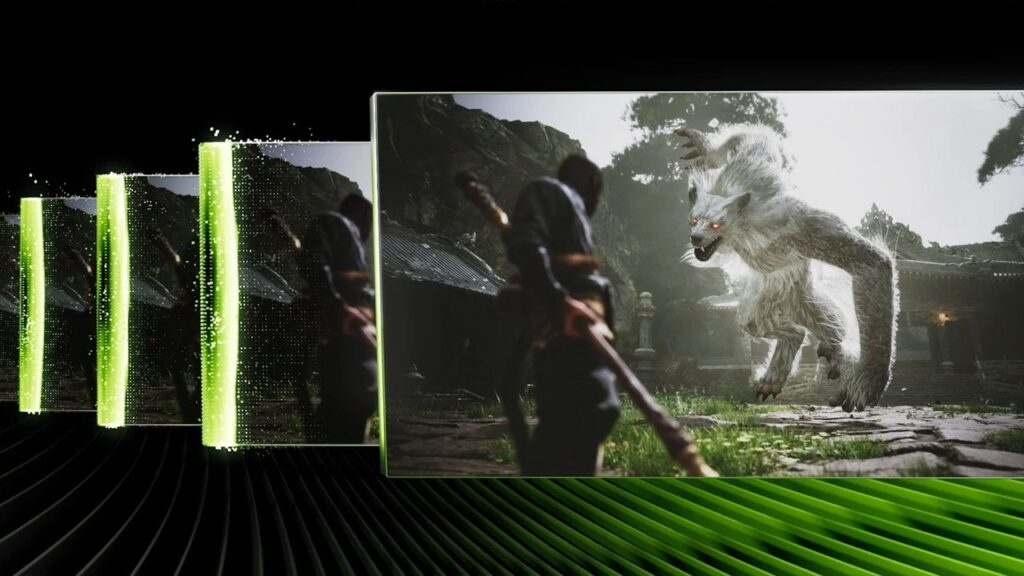

The Consumer Electronics Show 2026 (CES) kicked off in Las Vegas, bringing with it a wave of cutting-edge technology announcements. Among the highlights, NVIDIA showcased its latest innovations, including AI models for autonomous vehicles and robotic demonstrations. However, the gaming community’s attention is firmly focused on the company’s groundbreaking gaming technology announcements.
NVIDIA DLSS 4.5: Next-Generation AI Upscaling
NVIDIA has officially unveiled a major update to its Deep Learning Super Sampling (DLSS) technology. Version 4.5 introduces a second-generation AI model with significantly improved capabilities, alongside an innovative 6x multi-frame generation mode designed exclusively for flagship RTX 50-series graphics cards.
The upgraded second-generation AI model features enhanced scene recognition capabilities, leveraging engine data to improve lighting accuracy and render motion with greater precision. These improvements aim to deliver superior image quality while reducing visual artifacts such as ghosting and flickering.
According to Henry Lin, Director of Product Management at NVIDIA, the computational power of the second-generation model is five times greater than the original AI model. This substantial increase fully utilizes the enhanced tensor cores found in GeForce RTX 40-series and 50-series graphics cards.
Image Quality Comparison: DLSS 4 vs DLSS 4.5 (Black Myth: Wukong)Additional Comparison Examples
DLSS 4.5 is now available across all RTX graphics cards, though it delivers optimal performance on 40-series and 50-series models. This spring, the revolutionary 6x multi-frame generation mode will launch for 50-series cards, enabling 4K gaming at a target refresh rate of 240 Hz. The system will generate five additional frames for every fully rendered frame, compared to three frames in the previous version.
Performance Comparison: DLSS 4 vs DLSS 4.5 (Black Myth: Wukong)
Coming this spring, GeForce RTX 50-series owners will gain access to dynamic multi-frame generation mode. NVIDIA compares this feature to an automatic transmission for your graphics card. In this mode, the system automatically switches between different fps multipliers to achieve the perfect balance between frame rate, image quality, and responsiveness.
“In graphically demanding scenes, the system ‘shifts to a higher gear,’ increasing frame generation to compensate for fps drops and maintain perfectly smooth visuals on high-refresh-rate monitors. As the system load decreases, it smoothly ‘reduces rpm,’ creating only the necessary minimum of frames.”— Henry Lin, NVIDIA Director of Product Management
NVIDIA Technologies in Upcoming Games
Since its January 2025 launch, DLSS 4 support has expanded to over 250 games. This number continues to grow with upcoming releases. Here are several notable examples:
007 First Light
IO Interactive’s spy thriller will support DLSS 4 with multi-frame generation. To create realistic environments, the development team has implemented volumetric smoke and fog systems. The game will also feature an upgraded AI system to make NPC interactions feel more natural and authentic.
Pragmata
The PC version of Pragmata will receive DLSS 4 support and full path tracing, delivering more natural reflections, shadows, and indirect lighting. These enhancements will significantly increase immersion and realism. Multi-frame generation will also be implemented.
Resident Evil Requiem
The developers of Resident Evil Requiem have released a trailer showcasing path tracing on PC. The ninth installment in the series will also feature DLSS 4 with multi-frame generation.
Phantom Blade Zero
When Phantom Blade Zero launches in September 2026, it will support DLSS 4 with multi-frame generation. The PC version will include exclusive features such as ray-traced reflections and shadows.
Active Matter
The multiplayer PvPvE shooter Active Matter from Gaijin Entertainment will be equipped with DLSS 4 and multi-frame generation, ray-traced global illumination, ray-traced shadows and reflections, plus NVIDIA Reflex support for reduced input latency.
DEFECT
At launch, the cyberpunk shooter DEFECT will receive DLSS 4 support with multi-frame generation. Studio emptyvessel has prepared an exclusive trailer demonstrating these technologies.
Additional Announcements
- G-SYNC Pulsar: NVIDIA has upgraded its G-SYNC technology. G-SYNC Pulsar ensures stutter-free operation with smooth motion and establishes a new gold standard for visual clarity and precision through innovative dynamic backlight strobing technology. Monitors featuring G-SYNC Pulsar will be available starting January 7.
- Partner Products: NVIDIA partners have showcased new variations of current graphics cards, new laptops, and displays with G-SYNC Pulsar support.
- RTX Remix Update: Thanks to an upcoming NVIDIA RTX Remix update launching later this month, mod creators will be able to add completely new dynamic effects to their classic game projects.
- GeForce NOW Expansion: The GeForce NOW service will receive native applications for Linux and Amazon FireTV, HOTAS controller support, and much more.

Comments (0)
Sign In / Sign Up
Sign in to leave a comment.
No comments yet
Be the first one to share your thoughts!