

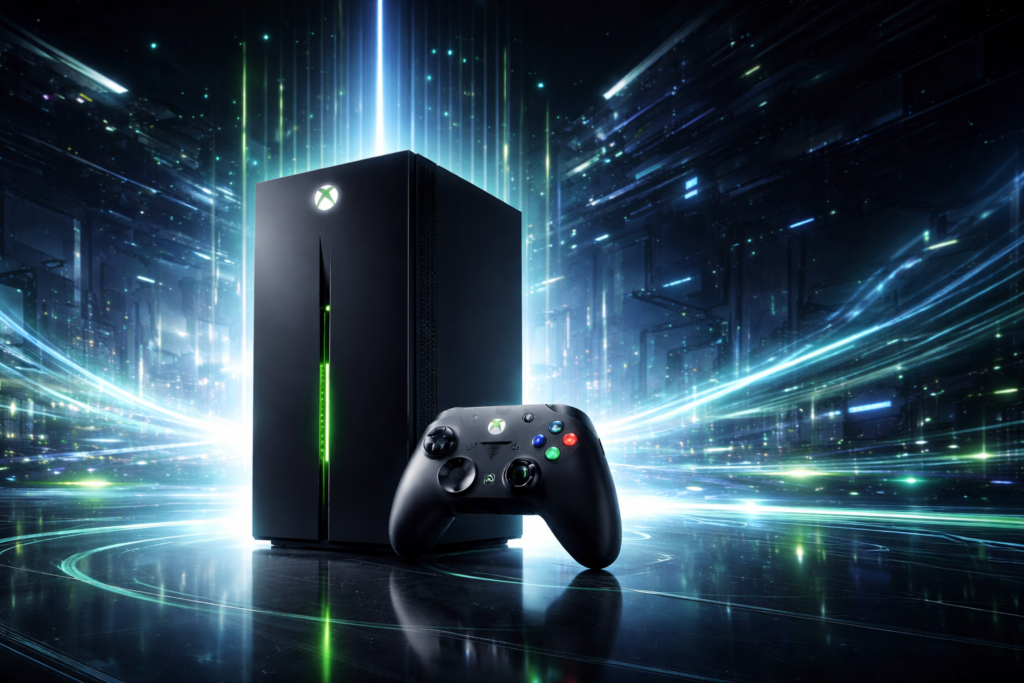

Microsoft has been teasing its next-generation Xbox for a while now, but concrete details have been scarce. That changed last week at the Game Developers Conference in San Francisco, where the company finally went on record with technical specifics about Project Helix — and the promises are substantial.
What Is Project Helix
Project Helix is the working name for Microsoft’s next-generation Xbox console. Jason Ronald, VP of Next Generation at Microsoft, took the GDC stage to detail the new platform and confirmed several key specs.
At its core is a custom AMD System-on-Chip (SoC), co-designed around the next generation of DirectX and AMD’s FSR upscaling technology. Ronald placed particular emphasis on ray tracing performance, stating that Project Helix will deliver “an order of magnitude leap” beyond what’s currently possible on the Xbox Series X and S.
If that’s more than marketing language, it points to a fundamentally different level of lighting, shadows, and visual fidelity — precisely what ray tracing has promised but never fully delivered on current-gen hardware due to the sheer computational cost involved.
Xbox and PC: One Platform
Perhaps Project Helix’s most defining feature — one Microsoft has been signaling for some time — is full PC game compatibility. Ronald made it official at GDC: the new console will run both Xbox titles and standard PC games.
Microsoft’s reasoning is straightforward: the old divisions between “console gamers,” “PC gamers,” and “mobile gamers” no longer hold. Ronald argued that player behavior has fundamentally shifted, and Microsoft is building a platform that reflects this new reality — one without hard borders between devices.
This also explains why Microsoft is bringing “Xbox Mode” to Windows 11 starting next month. The mode will carry over features from the handheld Xbox Ally device to desktop PCs, continuing a steady convergence of Windows gaming and the console experience. The wall between Xbox and PC is being dismantled from both sides.
Dev Kits Land in 2027
Ronald confirmed that Project Helix development kits will be sent to studios next year. This is standard pre-launch procedure — developers need hardware in hand well before a console ships to have games ready at launch. No release date for the console itself was announced, but the next-generation development cycle is clearly underway.
Microsoft also touched on game preservation, with Ronald teasing the ability to play classic games in “new ways” later this year. No specifics were given, but the implication points toward enhanced versions, AI upscaling of older titles, or expanded backward compatibility features.
Why This Matters Right Now
The GDC announcement landed at a particularly revealing moment for the industry. In the same week, Sony’s retreat from PC ports is making headlines, and Valve is pressing ahead with the Steam Machine ahead of its 2026 launch. Three of gaming’s biggest players are simultaneously rethinking what a “gaming platform” even means.
Microsoft is betting on erasing boundaries: one library, everywhere. Sony is doubling down on them: PlayStation means games you can’t get anywhere else. Valve is trying to occupy the middle ground with a console that is technically a PC.
Project Helix is a direct challenge to not just the PlayStation 6, but also to the Steam Machine. If Microsoft delivers on its performance promises while offering access to a vast PC game library, the case for buying a separate dedicated console — or a separate gaming PC — gets harder to make.
Bottom Line
Project Helix is still a set of promises without a price tag or firm release date. But for the first time in a while, Microsoft is being specific: a custom AMD SoC, next-generation ray tracing, full PC game compatibility, and dev kits shipping in 2027.
The next year will reveal whether Project Helix becomes the device that finally makes gamers question whether they need a separate gaming PC — or a separate PlayStation.
Sources: VGC, GDC 2026, Jason Ronald’s official presentation

Comments (0)
Sign In / Sign Up
Sign in to leave a comment.
No comments yet
Be the first one to share your thoughts!