

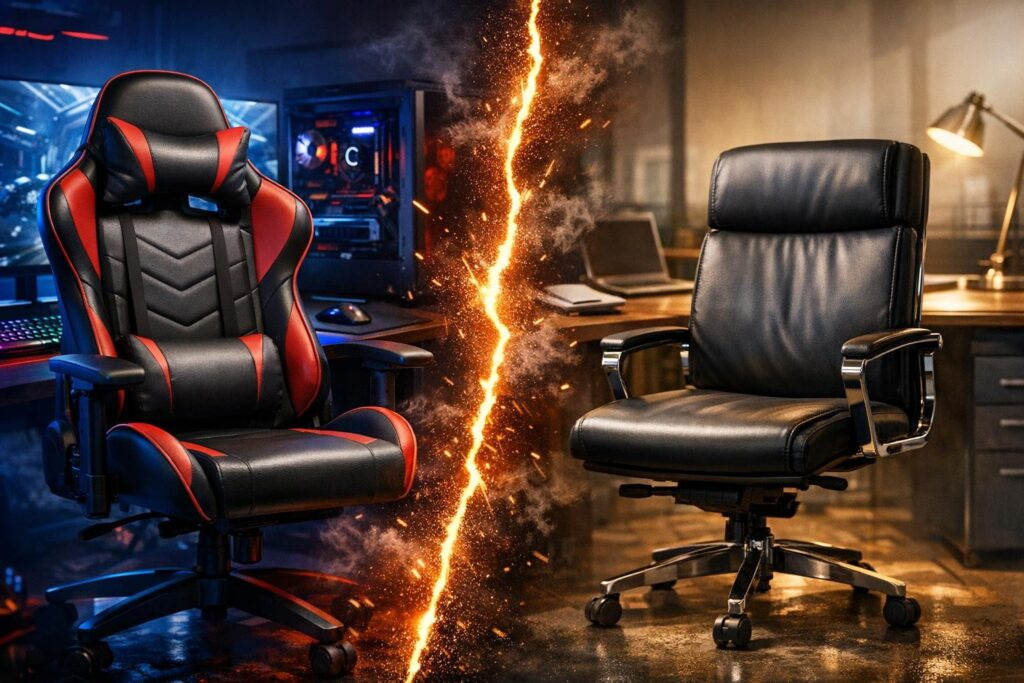

Spending over eight hours glued to your screen? Whether you’re grinding ranked matches or crushing deadlines from home, your chair isn’t just furniture—it’s your battle station foundation. The gaming chair vs office chair debate has been raging for years, and honestly, there’s no one-size-fits-all winner. But here’s the thing: understanding the real differences in ergonomics, build quality, and long-term comfort will help you make a choice your back won’t regret five years down the line.
The Style Factor: Racing Aesthetics vs Professional Minimalism
Gaming chairs are the rockstars of seating. Think aggressive racing seat design, oversized winged backrests, and color schemes that scream “I just pulled an all-nighter farming legendary loot.” They come loaded with lumbar pillows and neck cushions that dangle from straps, giving you that immersive cockpit vibe perfect for streaming setups.
Office chairs? Total opposite energy. They’re the quiet professionals—flat cushions, neutral tones, zero flashy logos. They blend into any home office without begging for attention. If your workspace doubles as a backdrop for client calls, an office chair won’t raise eyebrows when your camera turns on.
Here’s the practical breakdown:
- Gaming chairs dominate visual presence and eat up floor space
- Office chairs keep things low-key and versatile
- Your choice depends on whether your setup is a gaming shrine or a multi-purpose workspace
Ergonomics Showdown: Which Chair Actually Supports Your Spine?
Both chair types claim to support marathon sitting sessions, but the devil’s in the details. When comparing gaming chair vs office chair for long-term use, office chairs consistently pull ahead in ergonomic precision.
Adjustment Options That Matter
Quality office chairs pack synchro-tilt mechanisms where the backrest reclines faster than the seat pan—this keeps your feet planted while supporting your lower back through position changes. Premium models offer seat depth adjustment, forward tilt for active sitting, and independent lumbar height controls. Gaming chairs typically max out at basic tilt lock and armrest tweaks.
| Feature | Gaming Chair | Office Chair |
|---|---|---|
| Recline Range | Up to 180° (flat) | Usually 90-135° |
| Lumbar Support | Removable pillow | Built-in adjustable |
| Seat Depth | Fixed | Adjustable (premium) |
| Tilt Mechanism | Basic lock | Synchro-tilt |
The Pillow Problem
Those cushy neck and lumbar pillows on gaming chairs feel great for thirty minutes. Then they compress, shift out of position, or create pressure points you didn’t sign up for. Built-in ergonomic support in office chairs maintains consistent positioning without the constant readjustment dance.
Proper lumbar support isn’t about softness—it’s about maintaining your spine’s natural curve during extended sitting periods.
Durability Deep Dive: What’s Your Chair’s Life Expectancy?
This is where office chairs absolutely dominate the gaming chair vs office chair longevity battle. We’re talking about fundamentally different design philosophies.
Office Chair Lifespan
Mid-range office chairs survive five to seven years of daily abuse. Premium ergonomic brands like Steelcase and Herman Miller routinely hit the twelve-year mark with full warranties backing that claim. They’re engineered for twenty-four-seven office environments where multiple users rotate through the same seat.
Construction quality makes the difference:
- Steel or aluminum frames versus plastic shells
- Breathable mesh that won’t sag versus foam that compresses permanently
- Commercial-grade hydraulic cylinders tested for hundreds of thousands of cycles
- Replaceable components instead of throwaway designs
Gaming Chair Reality Check
Gaming chairs focus budget allocation on aesthetic features rather than industrial-grade components. That racing-style stitching and RGB lighting integration? Cool for streams, but those dollars could’ve gone toward better mechanisms. Most gaming chairs show wear around the three to five year mark with heavy use, though specific longevity data remains surprisingly scarce from manufacturers.
Maintenance Moves That Extend Lifespan
- Check weight capacity ratings—exceeding limits accelerates failure
- Lubricate moving parts annually
- Vacuum and spot-clean upholstery monthly
- Tighten bolts every six months
- Replace worn casters before they damage floors
Price-to-Performance Analysis: Where’s Your Money Going?
Gaming chairs often command premium prices thanks to branding partnerships and design flourishes. Drop three hundred dollars on a gaming chair and you’re paying for style-forward aesthetics. Spend that same amount on an office chair and you’re getting advanced ergonomic adjustments plus better build materials.
The return on investment tilts heavily toward office chairs for long-term use. A quality ergonomic office chair that lasts ten years costs less annually than replacing budget gaming chairs every three years. Plus, avoiding back pain and posture problems? That’s value you can’t put a price tag on.
Real-World Use Cases: Matching Chair to Lifestyle
Choose Gaming Chairs If:
- Gaming comprises seventy percent or more of your sitting time
- You regularly stream and want that signature gaming setup aesthetic
- Deep recline for console gaming from your desk matters to you
- You’re under six feet tall (many gaming chairs fit smaller frames better)
Choose Office Chairs If:
- Work, study, or productivity tasks dominate your screen time
- You prioritize spine health and proper posture support
- Long-term value matters more than immediate style points
- You need professional appearance for video calls
- You’re willing to invest upfront for decade-long durability
The Hybrid Approach: Best of Both Worlds
Here’s a pro tip the marketing departments don’t want you to know: a premium ergonomic office chair handles gaming marathons better than most gaming chairs. The “gaming” label is often just marketing spin on inferior ergonomics wrapped in flashy upholstery.
Some newer brands are catching on, creating hybrid designs that merge gaming aesthetics with legitimate ergonomic engineering. Look for gaming chairs that ditch the pillow system for integrated lumbar support, offer synchro-tilt mechanisms, and provide transparent durability testing data.
Making Your Final Decision
The gaming chair vs office chair debate ultimately comes down to honest self-assessment. Track how you actually spend your sitting time for two weeks. If you’re typing, mousing, and leaning forward more than you’re leaning back with a controller, office chairs win every time.
Don’t skip the test-sit. Online reviews help, but nothing replaces parking yourself in the actual chair for twenty minutes. Pay attention to pressure points, whether your feet rest flat on the floor, and if the lumbar support hits your lower back correctly without adjustment gymnastics.
Your spine doesn’t care about RGB lighting or racing stripes. It cares about proper support during those eight-plus hour sessions. Choose accordingly, and your back will thank you thousands of sitting hours from now.
Frequently Asked Questions
Can gaming chairs really last as long as office chairs?
Generally no. While some premium gaming chairs approach office chair durability, most gaming chairs prioritize aesthetics over longevity. Office chairs from established ergonomic brands typically outlast gaming chairs by three to seven years with comparable use intensity.
Is the extra recline in gaming chairs worth it for gaming sessions?
It depends on your gaming style. Console gamers who use controllers might enjoy deeper recline positions. PC gamers who need keyboard and mouse access rarely use extreme recline angles during actual gameplay, making this feature more of a gimmick than practical benefit.
Why are office chairs so expensive compared to gaming chairs?
Premium office chairs cost more upfront because they’re engineered for commercial environments with rigorous durability testing, replaceable components, and extended warranties. Gaming chairs often allocate budget to visual design rather than industrial-grade mechanisms, creating a lower entry price but shorter lifespan.
Will an office chair hurt my gaming performance?
Not at all. Proper ergonomic support actually improves focus and reduces fatigue during extended gaming sessions. Many professional esports players use high-end office chairs rather than gaming chairs specifically because better posture support enhances endurance and reaction times.
How often should I replace my chair for optimal back health?
Quality office chairs maintain ergonomic effectiveness for seven to ten years. Budget chairs of any type should be evaluated after three to four years. Signs you need replacement include sagging cushions, failing hydraulics, broken adjustments, or developing back pain that wasn’t present when the chair was new.

Comments (0)
Sign In / Sign Up
Sign in to leave a comment.
No comments yet
Be the first one to share your thoughts!