

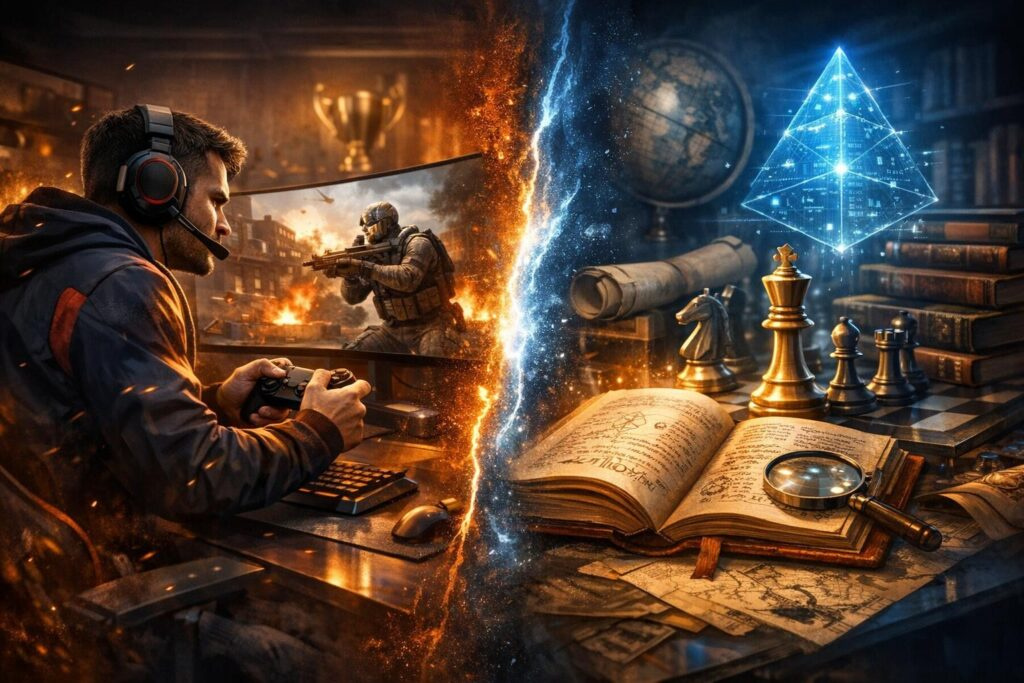

Every gamer has faced this choice: do you want games that test your lightning-fast reflexes, or do you prefer titles that challenge your brain and strategic thinking? Understanding the difference between skill-based games and knowledge-based games can completely transform how you approach gaming, help you pick titles that match your style, and even improve your performance across different genres.
The gaming world offers two distinct experiences that engage your mind in fundamentally different ways. Skill-based games reward quick reactions and physical execution, while knowledge-based games celebrate strategic thinking and accumulated wisdom. Let’s break down everything you need to know about these two gaming approaches so you can dominate in whichever arena you choose.
Understanding Skill-Based Games: When Reflexes Rule
Skill-based games put your physical abilities front and center. These titles demand quick reactions, precise timing, and muscle memory that develops through countless hours of practice. Think about games where you need to execute perfect combos, nail difficult jumps, or outshoot opponents in split-second encounters.
What makes these games special is the flow state they create. When you’re perfectly matched against a challenge, time seems to slow down. Your fingers move automatically, responding to threats before your conscious mind even registers them. This automatic execution is what separates beginners from masters in competitive shooters, fighting games, and platformers.
Core Characteristics of Skill-Based Gaming
These games share several defining features that set them apart:
- Low cognitive load during gameplay once you’ve learned the basics
- Improvement through repetition and practice rather than study
- Mistakes that are immediately obvious and quickly corrected
- Physical execution matters more than planning
- Competitive balance based on player ability rather than hidden information
Popular examples include first-person shooters like Counter-Strike, rhythm games like Beat Saber, fast-paced platformers like Celeste, and competitive fighting games like Street Fighter. Even certain card games like poker incorporate skill elements through reading opponents and managing probabilities in real-time.
The Training Mindset for Skill Games
Getting better at skill-based games requires a specific approach. You need practice modes, training dummies, and repetition drills. Professional players spend hours warming up their aim or perfecting frame-perfect inputs. The path to mastery involves grinding mechanics until they become second nature.
The beauty of skill-based games lies in their fairness. When two players face off, the better player wins consistently. There’s no hidden information giving unfair advantages, just pure ability tested against ability.
Knowledge-Based Games: Where Strategy Wins
Knowledge-based games flip the script entirely. Instead of testing your reflexes, they challenge your understanding, strategic planning, and accumulated wisdom. These games reward players who study systems, memorize patterns, and discover optimal strategies through careful analysis.
The satisfaction in knowledge-based games comes from those breakthrough moments. You suddenly understand how different systems interact, discover a sequence that breaks the intended progression, or solve a puzzle that had you stumped for hours. That “eureka” feeling is what keeps players coming back.
What Defines Knowledge-Based Gaming
These titles emphasize mental engagement over physical execution:
- High cognitive load requiring active thinking during play
- Learning through experimentation and trial-and-error
- Mistakes that might not reveal themselves until much later
- Strategic planning that matters more than execution speed
- Progression tied to understanding rather than reflexes
Classic examples include puzzle games like The Witness, exploration-based titles like Outer Wilds, real-time strategy games like StarCraft, turn-based tactics games like XCOM, and trivia competitions. Even some action games like Dark Souls heavily emphasize knowledge of enemy patterns and level layouts.
Building Knowledge Game Mastery
Improving at knowledge-based games requires different techniques. You need to take notes, study game wikis, watch tutorial videos, and experiment with different approaches. The learning curve can feel steep at first, but each piece of information you acquire permanently improves your capability.
Comparing Both Gaming Styles: A Detailed Breakdown
To really understand how these gaming types differ, let’s examine them side by side across key dimensions:
| Aspect | Skill-Based Games | Knowledge-Based Games |
|---|---|---|
| Mental Load | Low during execution | High throughout play |
| Learning Method | Repetition and practice | Study and experimentation |
| Time to Competence | Faster with dedicated practice | Slower but more permanent |
| Error Feedback | Immediate and clear | Delayed and complex |
| Satisfaction Source | Flow state and execution | Discovery and insight |
| Competitive Edge | Physical practice | Information advantage |
The Hybrid Approach: Best of Both Worlds
Many modern games brilliantly combine both elements. Action RPGs require knowledge of enemy weaknesses but also demand skilled combat execution. Card games like Magic: The Gathering need strategic deck-building knowledge and skillful play decisions under pressure. Sports games blend tactical understanding with precise controller inputs.
These hybrid titles often provide the most engaging experiences because they keep both your mind and reflexes sharp. You can’t succeed through knowledge alone if you can’t execute, and raw skill won’t help if you’re making strategically poor decisions.
Choosing Your Gaming Path: Which Style Fits You?
Your preference between skill-based and knowledge-based games often reflects your personality and available time. Skill games provide immediate feedback and quick sessions perfect for short gaming windows. Knowledge games offer deeper experiences that reward long-term investment and patience.
Benefits of Skill-Focused Gaming
- Quick dopamine hits from successful execution
- Clear improvement metrics through practice
- Competitive scenes with fair player-versus-player contests
- Easier to pick up after breaks since muscle memory persists
- Social aspects through direct competition
Advantages of Knowledge-Focused Gaming
- Accessible to players with slower reflexes
- Deeper strategic satisfaction
- Knowledge transfers between similar games
- Less frustration from physical execution failures
- Engaging community discussions about strategies
Practical Tips for Improving in Both Categories
Regardless of which type appeals to you more, specific training methods can accelerate your improvement.
For Skill-Based Games:
Focus on deliberate practice targeting your weakest areas. Use aim trainers for shooters, practice difficult sections repeatedly in platformers, and drill combos in fighting games. Record your gameplay to identify mistakes you’re making unconsciously. Most importantly, warm up before competitive sessions to get your reflexes firing.
For Knowledge-Based Games:
Take notes on discoveries and patterns you notice. Watch high-level players to learn strategies you might not discover independently. Join community discussions to share knowledge and learn from others. Don’t be afraid to consult guides when genuinely stuck, but try solving puzzles yourself first to maximize satisfaction.
The Future of Gaming: Evolving Challenges
Modern game design increasingly recognizes that players enjoy different challenge types. Many developers now include difficulty options that adjust whether games test knowledge or skill more heavily. Accessibility features let players with limited reflexes enjoy skill-based games, while time limits can add skill elements to traditionally knowledge-focused genres.
The rise of roguelikes and roguelites perfectly demonstrates this evolution. These games combine knowledge accumulation across runs with skillful execution during each attempt. Every death teaches you something new while also giving you opportunities to practice your mechanical abilities.
The best gamers understand both skill and knowledge matter. Converting knowledge into automatic skill through practice represents the highest level of gaming mastery.
Understanding the distinction between skill-based and knowledge-based games empowers you to choose experiences that match your preferences and improve more effectively. Whether you crave the adrenaline rush of perfect execution or the satisfaction of strategic insight, there’s an entire gaming world waiting for you. The smartest approach? Explore both types and develop a well-rounded gaming skillset that serves you across every genre and challenge.
Frequently Asked Questions
Can skill-based games also require knowledge?
Absolutely. Most skill-based games include knowledge components like understanding character matchups in fighting games or learning map layouts in shooters. However, physical execution remains the primary challenge. The distinction refers to which element dominates the gameplay experience rather than being mutually exclusive categories.
Which type of game is better for beginners?
Knowledge-based games often feel more accessible initially because they don’t require developed reflexes. However, skill-based games with good tutorials can provide clearer progression feedback. The best beginner choice depends on personal preference: whether you prefer thinking through problems or developing physical coordination.
Do knowledge-based games have competitive scenes?
Yes, games like chess, StarCraft, and card games have thriving competitive communities. Knowledge-based competition focuses on strategic preparation, adaptation, and deeper understanding of game systems. These competitions can be just as intense as skill-based esports, simply testing different player capabilities.
How long does it take to get good at each type?
Skill-based games typically show improvement within weeks of dedicated practice as muscle memory develops. Knowledge-based games may take longer initially but provide more permanent advancement since learned information stays with you. Both require hundreds of hours to reach expert levels in competitive environments.
Can older gamers compete in skill-based games?
While reaction times do decline slightly with age, experience and game knowledge can compensate significantly. Many professional gamers compete successfully into their thirties. Additionally, not all skill-based games demand extreme reflexes. Strategic positioning and smart decision-making often matter more than raw speed, allowing experienced players to remain competitive.

Comments (0)
Sign In / Sign Up
Sign in to leave a comment.
No comments yet
Be the first one to share your thoughts!